
- Online only
- On sale!

.
Dosage and administration
Administration: During or after the meal, swallow 1 capsule together with water, or sprinkle the content of the capsule on your food.
Dosage:
First 2 months: 3 times 1 capsule daily
Next 2 months: In case of a positive result, 2 times 1 capsule daily
After 4 months, you can consider the following:
• Continue taking 2 times 1 capsule daily.
• Reduce the ingestion to 1 time 1 capsule daily.
• Stop the ingestion.
In case of regression, it is recommended to increase the dosage to 2 or 3 times 1 capsule daily.
It is possible to continue taking PEA NATUREL Palmitoylethanolamide in the correct dosage.
Do not exceed the recommended daily dosage.
Daily dosage:
PEA NATUREL Palmitoylethanolamide can be easily swallowed, or for patients with severe swallowing problems, the capsules can be openend and PEA can be sprinkeled over a meal or mixed with yoghurt or so.
PEA NATUREL can also be taken easily under the tongue, by opening the special designed capsule and poring the powder on a spoon and getting it under the tongue (especially of use for patients suffering great pain and for instance in Lou Gehrig’s disease). Or the capsule can easily be swallowed.
Dose recommendations of PEA NATUREL
Dose recommendation: start with 1200 mg daily in 2 to 3 doses (e.g. 2 capsules after breakfast and 1 capsule after diner). In case of severe pain, migraine or for special indications such as Lou Gehrig's disease it is recommended to open the capsule and put the PEA under the tongue for longer periodes of time. The PEA dissolves in the mouth and is absorbed via the oral mucosa to enter directly into the body, not being partly digested in the gut. This gives a jumpstart which might be desirable, but is not always necessary.
PEA is the body’s own modulator, and not a painkiller such as NSAID's and morphine. It does mostly need some weeks to slowly bring the body in balance on a number of biological levels. As PEA has a number of modulating effects, both on the short term as well as slowly increasing, there are patients experiencing quick pain relief within some days. There are also patients who need more time (especially in chronic pain situations). Therefore the recommendation is to test the efficacy of PEA during two months in cases of chronic pain before deciding on its efficacy.
If pain decreases more than 30% one can reduce the dose of PEA NATUREL to 2 times 400 mg. If pain increases under Pea treatment, as some chronic pain syndromes sometimes waxes and wanes (given the weather, given excercise, food, etc) it is recommended to increase the dose to 800 mg twice daily.
.
Warnings
• It is not allowed to use food supplements as replacement for a varied diet.
• Keep this food supplement dry and at room temperature. Keep out of reach of small children.
.
Content and ingredients
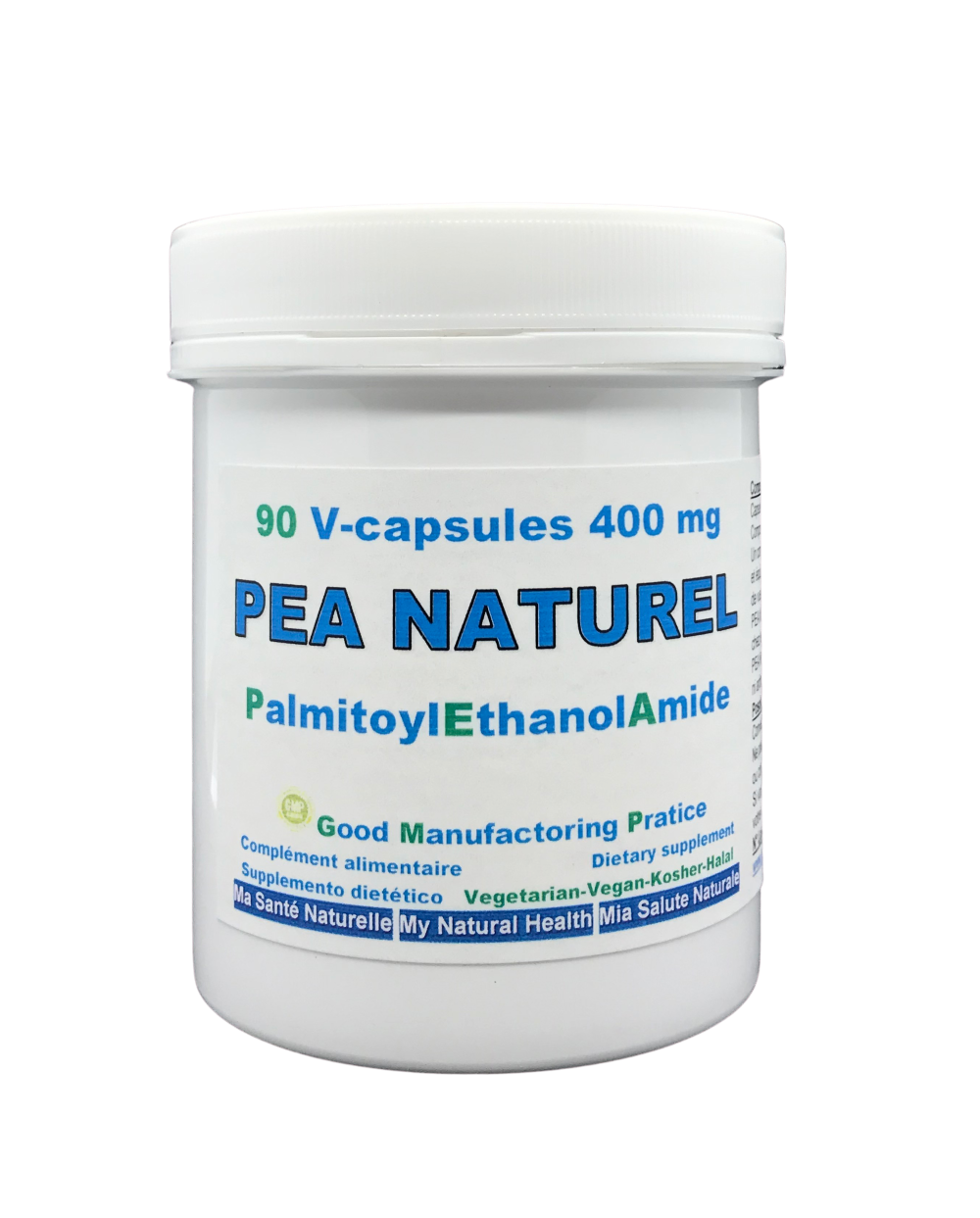
90 plant-based capsules
Each capsule contains 400 mg palmitoylethanolamide (PEA)
Ingredients: palmitoylethanolamide, hydroxypropylmethylcellulose (plant-based capsule)
Therapists newsletter
Palmitoylethanolamide (PEA) is hot. Since 2005, PEA has been of scientific interest. Recently, several scientific arguments were published that clearly indicate that PEA in 100% pure form -
as is used in PEA NATUREL Palmitoylethanolamide - is the most proper form for using PEA.
We quote one of the authors:’ …the preference should be for the time being to treat patients with pure PEA without any of these additives’. (1)
Treatment of various disorders that are characterised by chronic pains or infections with natural PEA has been extensively discussed in two recent Dutch publications that appeared in the magazines PlaceboNocebo (2) and Physician, Therapist and Pharmacist (Dutch: Arts, Therapeut en Apotheker).(3)
The former article includes a table that provides an overview of the physiological effects of PEA; this table is provided below. The table summarises many of the characteristics of PEA and has been created based on the most recent study results. The harmonising effect of PEA is striking, which is the result of various points of action:
Characteristics of PEA
This year, several Dutch physicians jointly published an article with an American pain specialist about the value of PEA in unexplainable vaginal pains, a common disorder with only few treatments. (4) Furthermore, it has become more and more clear that PEA protects many cells, such as nerve cells, against harmful irritations. (5) PEA exerts this protective mechanism by calming down overactive inflammatory genes in the cell nucleus. As early as in the 1980s, it was discovered that cells that are threatened produce PEA to protect themselves. Recently, this self-regulating protective mechanism has once again become clear. For example in eczema, a chronic infection, the skin produces more PEA in order to contain the infection. (6)
In this way, PEA continues to be of great interest and fortunately there are increasingly more therapists and physicians who are aware of the characteristics of this fascinating natural substance. Especially the fact that PEA is easy to combine with any other medication or supplement is a great advantage to its users.
References:
1. Kriek R. Palmitoylethanolamide: problems regarding micronization, ultra-micronization and additives. Inflammopharmacology. 2014 Mar 20.
2. Hilda Maris, Jan M. Keppel Hesselink. Palmitoylethanolamide (PEA): een natuurlijke pijnstiller en veel meer. PlaceboNocebo, wetenschap, voeding, bewustzijn, harmonie: 2013, jaargang 3, nummer 13:36-38
3. Stichting Orthokennis. Palmitoylethanolamide, effectieve lichaamseigen pijnstiller en ontstekingsremmer. Arts, therapeut en apotheker, 2014: jaargang 15, nr 2: 54-58
4. Keppel Hesselink JM, Kopsky DJ, Sajben NL. Vulvodynia and proctodynia treated with topical baclofen 5 % and palmitoylethanolamide. Arch Gynecol Obstet. 2014 Apr 2.
5. Fidaleo M, Fanelli F, Ceru MP, Moreno S. Neuroprotective Properties of Peroxisome Proliferator-Activated Receptor Alpha (PPARα) and its Lipid Ligands. Curr Med Chem. 2014 Mar 3.
6. Abramo F, Campora L, Albanese F, della Valle MF, Cristino L, Petrosino S, Di Marzo V, Miragliotta V. Increased levels of palmitoylethanolamide and other bioactive lipid mediators and enhanced local mast cell proliferation in canine atopic dermatitis.
BMC Vet Res. 2014 Jan 14;10:21. doi: 10.1186/1746-6148-10-21.
.